Somewhere in your family is a grandmother, an aunt, or a parent who used to live five minutes away and now lives five states away. Two studies spanning nearly four centuries of family records suggest that move changed more than anyone realized.
Scientists Tracked Two Centuries of Family Records. What Helped a Child Survive Was Never How Much Grandma Loved Them. It Was How Close She Lived.
A team led by Sacha Engelhardt tracked 3,382 grandmothers and 56,767 grandchildren from 17th and 18th century Quebec. A companion study led by Simon Chapman followed 5,815 Finnish children born between 1731 and 1895, using two centuries of Lutheran church records. Both were published the same week in February 2019 in Current Biology. Neither found that a grandmother's love mattered less across distance. They found her help could not cross it.
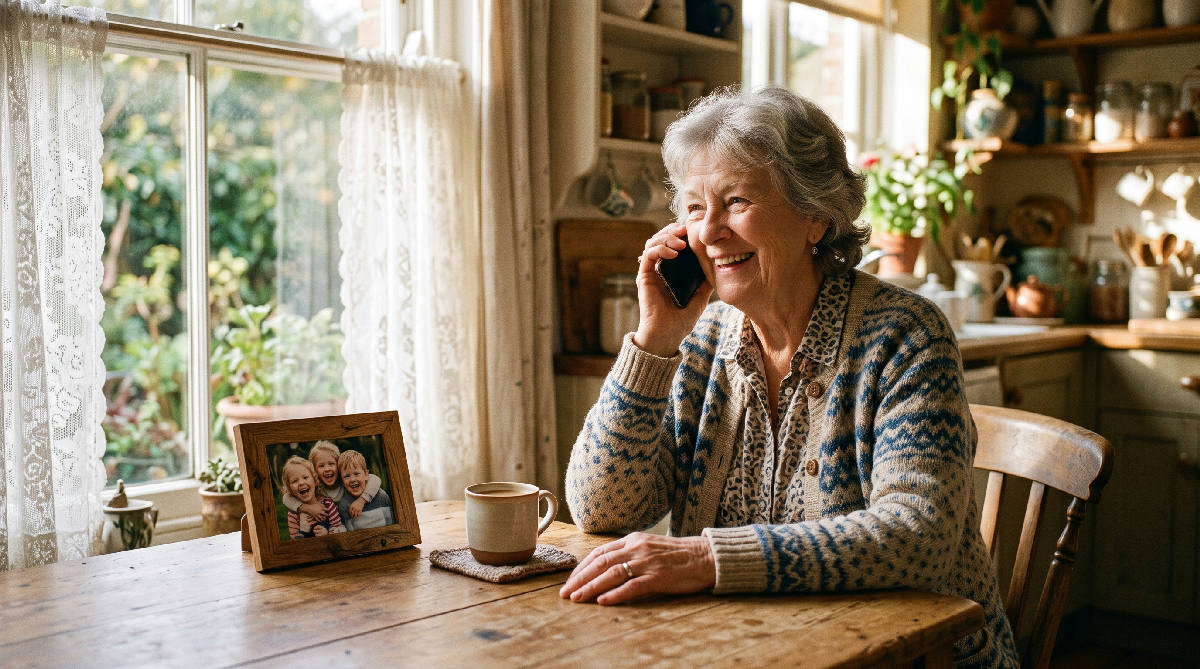
Every family has a version of this: someone who used to be five minutes away and now is not. A grandmother, an aunt, a parent. Nobody argues the love changed. **What two research teams wanted to know was whether the help did, the actual, measurable difference a family member's presence made in a child's life.**
So they went looking for the largest, longest records they could find. One team combed 17th and 18th century parish and settlement records from the St. Lawrence Valley in Quebec, tracking three generations of French settler families. Another combed two centuries of Lutheran church records from pre-industrial Finland. **Neither study could ask a single family a single question. They didn't need to. They had tens of thousands of family histories already written down, waiting to be read.**
Both papers came out the same week, in February 2019, in the journal Current Biology, published together under a shared banner on grandmothering in space and time. **The two findings, one about miles and one about years, turned out to be the same finding wearing different clothes.**
1. The 325 kilometers in Quebec
Sacha Engelhardt's team built a multigenerational database of French settler families in the St. Lawrence Valley, using records running from 1621 to 1799. They tracked which daughters had a living mother nearby when they started having children of their own, and which did not.
**When a mother was alive and close, her daughters had, on average, 2.08 more children over their lifetime.** That advantage did not disappear all at once. It shrank steadily with every kilometer of distance between them, and by roughly 325 kilometers, about the distance from New York City to Washington, D.C., it was gone. Sisters who had settled that far from their mother had close to 30 percent fewer surviving children than sisters who had stayed near her.
A living grandmother helped. A grandmother too far away to reach did not, no matter how much she loved her daughter.
2. The age cutoff in Finland
Simon Chapman's team asked a related but different question, using 5,815 Finnish children born between 1731 and 1895: not how far away a grandmother lived, but how old she was. **A maternal grandmother between 50 and 75, living nearby, raised her grandchildren's odds of survival by about 30 percent, with the benefit peaking while she was in her early sixties.**
Past age 75, that benefit disappeared. And for one specific group, paternal grandmothers over 75, the researchers found the opposite of help: grandchildren under age two in those households had **37 percent higher mortality**. The likely reason is not unkindness. It is competition for the same limited food and resources in a household stretched thin, a finding the researchers described as a historical version of the modern sandwich generation.
It was never simply whether a grandmother was alive. It was whether she was still able to give.
3. What both studies actually measured
Neither team set out to measure love, and neither found any reason to think it changed. What changed, in Quebec and in Finland, in the 1600s and in the 1800s, was reach: how close, and how able, a grandmother was to actually show up for her family. **The love was the constant. The outcome moved with the distance.**
Distance is a smaller problem now than it was for a Quebec settler or a Finnish farming family. A phone call closes it instantly. **What has not gotten easier is doing something with that call besides small talk.** With LifeScribe, Ari calls and asks a real question, so the reach a phone now makes possible actually gets used for something worth keeping: the story, in her own words, while she is still the one able to tell it.
Distance used to decide what a grandmother could give. Today it only decides whether anyone picks up the phone.
My grandmother moved two states away when I was in college, and for years our calls were five minutes of how's the weather. I set her up with Ari on a whim last spring. She has told my kids more about her childhood in six months of those calls than I learned in twenty years of holidays together.Renee, 44, recording her grandmother's stories on Ari
What you get with LifeScribe
- Two independent studies, one in 17th century Quebec and one in 18th and 19th century Finland, found the same pattern: what helped a family was never a grandmother's love. It was her reach.
- Ari calls and asks a real question, so a phone call across any distance turns into more than small talk.
- What gets kept is not just contact. It is the story itself, in her own words, before reach runs out.
- Built on documented research: Engelhardt et al., 2019, Current Biology (Quebec settler families), and Chapman et al., 2019, Current Biology (pre-industrial Finland).
Start free, with nothing to lose
Try it on your next call with a grandparent, free. Nothing to install, nothing to schedule around. If it does not feel like it kept something real, you have lost nothing but a few minutes of a call you could be having anyway.
**Reach fades before love does.** A grandmother two states away can love a grandchild every bit as much as one next door. Two centuries of family records say only one of them gets the chance to actually pass anything down.
Do not let distance decide what your family gets to know. Let Ari make the call count.
Ari calls and asks a real question, so what a grandmother has to give does not depend on how many miles are between you.
Questions grandparents ask us
What did the two studies actually find?
Engelhardt and colleagues (2019, Current Biology) tracked 3,382 grandmothers and 56,767 grandchildren in 17th and 18th century Quebec and found a grandmother's benefit to her daughter's fertility shrank with distance, disappearing by about 325 kilometers. Chapman and colleagues (2019, Current Biology) followed 5,815 Finnish children born 1731 to 1895 and found a grandmother's benefit to grandchild survival depended on her age, peaking in her early sixties and disappearing by 75.
Was it really about love, or something else?
Something else. Neither study measured or found any change in affection. What changed was a grandmother's practical ability to help, shaped by how far away she lived or how much she still had left to give physically.
Why did grandmothers over 75 sometimes correlate with worse outcomes?
In the Finnish study, paternal grandmothers over 75 were associated with 37 percent higher mortality in grandchildren under age two, likely reflecting competition for scarce household resources rather than any lack of care, what the researchers described as a historical sandwich generation.
Does this still apply now that distance is easy to close with a phone?
The physical distance is easier to close than it was for a 17th century settler family. What the research points to is not solved by proximity alone, it is solved by what a family actually does with the contact it has.
Why does this matter for recording a family story?
If a grandmother's practical ability to help and be present has a real, limited window, in age or in reach, then the ordinary calls families already have are worth more than they get credit for. Recording what gets said on those calls keeps what the window allowed, before it closes.