A hospice study built around one recorded conversation
Doctors Asked Dying Patients One Question and Wrote Down the Answer. Most Families Said It Helped Them Grieve.
Doctor Harvey Chochinov asked terminally ill patients a short list of questions about what they wanted remembered, wrote down what they said, and gave it back as a keepsake. Years later, most families said they still had it.
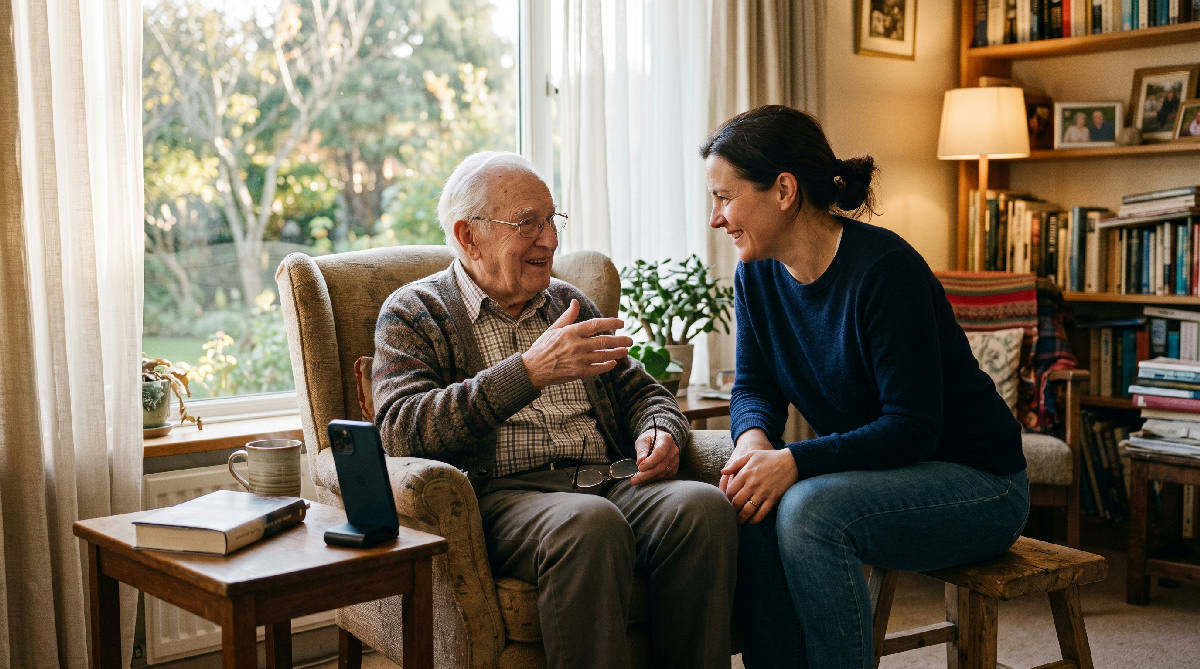
In the early 2000s, psychiatrist Harvey Chochinov and his colleagues at the University of Manitoba were looking for a way to ease the psychological weight that comes with knowing your time is limited. What they built was not a medication or a procedure. It was a single guided conversation.
They called it Dignity Therapy. A patient sits down with a trained interviewer and works through a short set of questions: what are you most proud of, what have you learned that you want to pass on, what do you want the people you love to know. The conversation is recorded, lightly edited for clarity, and handed back to the patient as a written document, something they can choose to give to whoever they want.
**In 2005, Chochinov published results from 100 terminally ill patients in the Journal of Clinical Oncology. Ninety-one percent said they were satisfied with the process. Seventy-six percent reported a heightened sense of dignity. Ninety-five percent said they would recommend it to other patients and their families.**
1. The document outlived the conversation
The interview itself usually took less than an hour. What happened afterward is the part that stuck. Researchers followed up with the families of patients who had completed Dignity Therapy, after the patient had died, and asked what became of the document.
**Seventy-eight percent of family members said the document had become a source of comfort during their grief, something they went back to.** Not a photograph. Not a memory someone else described secondhand. The person's own words, in their own voice, about what mattered to them.
The conversation ended in an afternoon. What it left behind kept being useful for years.
2. A randomized trial tried to test it properly
A single guided interview making people feel better is one thing. Proving it under a real controlled comparison is another. In 2011, Chochinov and colleagues published a randomized controlled trial in The Lancet Oncology, testing Dignity Therapy against usual end-of-life care in a much larger group of patients.
**The trial did not prove Dignity Therapy reduces measurable clinical distress like depression, and the researchers said so plainly.** But it held up on what patients reported about their own end-of-life experience, the part closest to what the families in the earlier follow-up had described. It was not just patients being polite to someone who had just spent an hour listening to them.
The comfort was not just a nice thing patients said in the moment. It held up when researchers tried to test it rigorously.
3. You do not need a diagnosis to ask the same questions
Strip away the clinical setting and the questions Chochinov's interviewers asked are ordinary ones: what are you proud of, what did you learn, what do you want us to know. Questions a daughter could ask her father over Sunday dinner. Questions a grandson could ask his grandmother on the porch.
**Nothing about the research says the comfort requires a terminal diagnosis to work, only that someone finally asked the question out loud and wrote down the answer.** That part does not have to wait for hospice. It can happen on an ordinary Tuesday, to someone in good health, for no reason other than deciding not to wait.
The questions worked because someone finally asked them and kept the answer. That does not require a crisis to start.
My grandmother is 89 and sharp as ever, nothing is wrong. I just started asking her the questions I was always a little scared to ask. Ari kept the recording, so my kids will have her actual voice, not just my memory of what she said.Elena, 31, recording her grandmother's story
What you get with LifeScribe
- Grounded in Harvey Chochinov's Dignity Therapy research (Journal of Clinical Oncology, 2005) and the 2011 randomized controlled trial published in The Lancet Oncology.
- Ari asks the kind of question a hospice interview asks, what do you want remembered, without needing a diagnosis or a crisis to bring it up.
- Every answer is kept in the person's own words and their own voice, not a summary written by someone else after the fact.
- No special appointment required. Ask it on a call you already have planned this week.
Start free, with nothing to lose
Try it on a call you already have planned this week, free. Nothing to install, nothing to learn. If nothing worth keeping comes up, you have lost nothing but a few minutes.
**None of Chochinov's patients needed a special occasion to answer the question, only someone willing to ask it and write down what they said.** You do not need one either.
Ask the question hospice researchers found worth writing down.
Pick a call already on your calendar this week. Let Ari ask what you want remembered, and keep the answer in their own voice.
Questions grandparents ask us
What is Dignity Therapy, and who created it?
Dignity Therapy is a short psychotherapy developed by Dr. Harvey Chochinov and colleagues at the University of Manitoba for people living with a life-limiting illness. It centers on one guided conversation about what a person most wants remembered, which is written down, lightly edited, and returned to them as a document to pass on to family.
What did the original 2005 study find?
Chochinov published results from 100 terminally ill patients in the Journal of Clinical Oncology in 2005. Ninety-one percent were satisfied with the process, seventy-six percent reported a heightened sense of dignity, and ninety-five percent said they would recommend it to other patients and their families.
Did families actually keep the document afterward?
In follow-up research, seventy-eight percent of family members said the document had become a source of comfort during their grief, something they returned to after the person had died.
Was the effect confirmed in a more rigorous study?
Yes. A 2011 randomized controlled trial published in The Lancet Oncology, also led by Chochinov, tested Dignity Therapy against usual care in a larger group of terminally ill patients. It confirmed the benefit to patients' self-reported end-of-life experience held up under controlled comparison, even though it did not prove the therapy reduces measurable clinical distress like depression.
How does this connect to LifeScribe?
Dignity Therapy shows that a single guided conversation, written down and given back to a family, can bring lasting comfort, and that it does not take a medical setting to matter. Ari asks a similar kind of question on a call you are already having, so the story does not have to wait for a diagnosis to be worth keeping.
https://getlifescribeapp.com/blog/the-one-hour-conversation-families-kept