For anyone who has sat beside a hospital bed, wishing they knew what to do
The Recordings That Helped Coma Patients Find Their Way Back
Doctors recorded family members telling old, familiar stories, then played the recordings back through headphones. The patients who heard them regained consciousness significantly faster than the ones who did not.
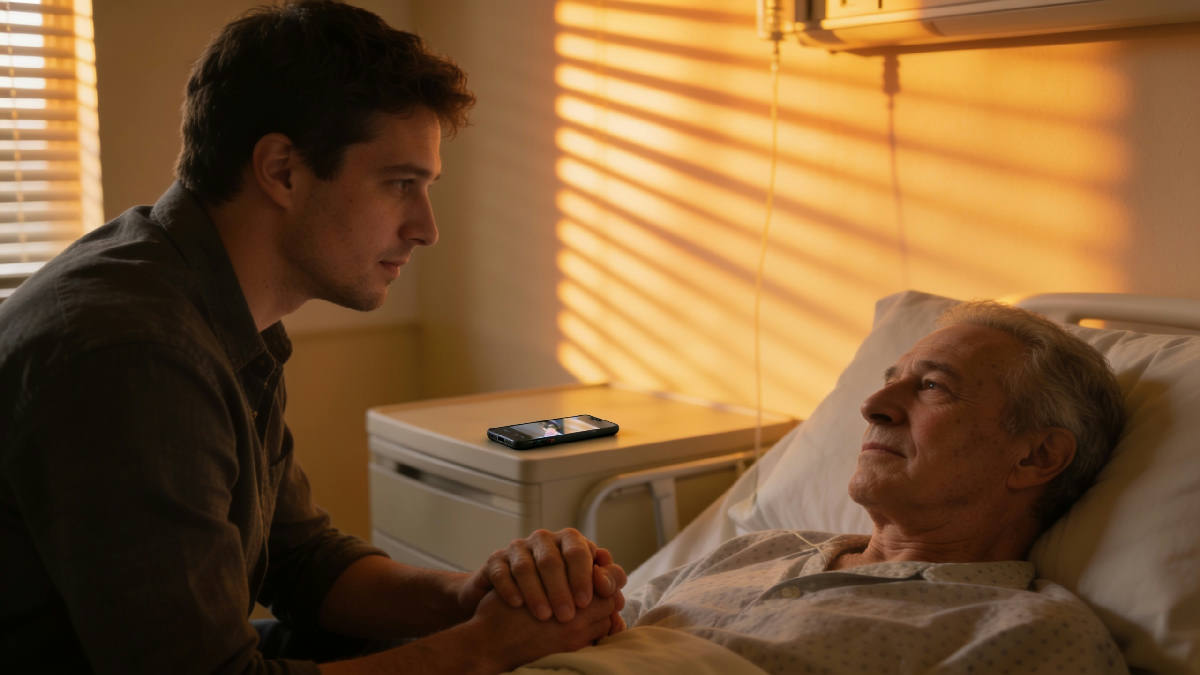
There is a particular helplessness in sitting beside someone who cannot answer you. Machines do their quiet work, and everyone in the room wants a job to do and cannot find one. A team of researchers at Northwestern University and the Hines VA Hospital set out to give families exactly that job.
They studied fifteen patients with severe traumatic brain injuries, all in a vegetative or minimally conscious state, roughly ten weeks after their injury on average. Family members recorded themselves telling at least eight stories about shared memories, ordinary ones, the kind you would tell at a kitchen table. Patients then listened to those recordings through headphones, four times a day, for six weeks.
The patients who heard their own family's voice, telling stories only their family could tell, regained consciousness significantly faster than patients in the placebo group, who heard silence instead. It is one of the more striking findings in recent rehabilitation research, and it is built entirely on something almost anyone can do: talk, and be recorded.
1. What the researchers actually did
The protocol had a name: Familiar Auditory Sensory Training, or FAST. It was tested as a randomized, placebo-controlled trial, the strongest kind of study design, led by neuroscientist Theresa Pape. **Family members recorded at least eight personal stories, memories only they would know, in their own voice.** No script written by a stranger, no generic narration. Just a parent, sibling, or spouse remembering out loud.
Those recordings played through headphones four times a day for six weeks. Researchers tracked responsiveness to commands and sensory stimuli throughout, alongside brain imaging that measured activity in language and memory regions.
The intervention was not a machine or a drug. It was a familiar voice, recorded, and played back on a schedule.
2. Why a familiar voice reaches where a stranger's cannot
The brain imaging is the part that stays with you. After six weeks, patients showed a measurable response when an unfamiliar voice told them a story, a sign the brain was learning to process and pay attention to speech again. But there was no change from baseline when a familiar voice spoke. **The brain already knew what to do with that voice.** It did not have to relearn how to listen to it.
Pape's team described it as exercising the circuits responsible for long term memory, using the one input built to reach them: the sound of someone the patient has heard their entire life. Selective attention, the ability to notice what matters and filter out what does not, showed its biggest gains in the first two weeks.
A stranger's voice has to be learned. A familiar voice is already wired in, which may be exactly why it works.
3. You do not need a hospital bed to understand what this means
This was a clinical study, not a consumer product, and no one should read it as a promise about any specific illness or injury. But it points at something worth sitting with regardless: **the sound of a familiar voice, telling a real story in that person's own words, carries weight that nothing else does.** That is true in a hospital, and it is true in an ordinary living room, on an ordinary Tuesday, with a parent who is perfectly healthy today.
Most families never get around to recording those stories until there is a reason to be afraid. This research is a reason to do it sooner. **A voice worth playing back in a hospital room is also a voice worth keeping while everyone involved is still just having a normal week.**
The researchers proved a familiar voice matters more than we assumed. The only real question left is whether you have recorded yours.
Reading about that study stopped me. I called my mom that same night, not because anything was wrong, but because I realized I had never actually recorded her telling one of her stories. Now I have four of them.Daniel, 44, preserving his mother's stories for his kids
What you get with LifeScribe
- No writing and no typing: your family member talks, LifeScribe does the rest.
- Works from an ordinary phone call, no app for them to learn.
- A warm guide that starts the conversation, so no one faces a blank page.
- Memories returned as first person keepsakes in their own voice.
- A living record your family can return to for generations.
Start free, with nothing to lose
Start with a single memory, free. There is nothing to install and nothing to learn beyond answering the phone. If one phone call and a preserved story does not feel worth it, you have lost a few minutes and gained one memory that would not otherwise exist.
You do not need a reason to be afraid to start. **The researchers only found out how much a familiar voice matters because a handful of families happened to have recordings ready when it counted.** Most families do not have that. Yours can.
You already know your voice matters. Record it before you need proof.
Pick a call you already have planned this week. Spend a few minutes of it capturing one story instead of letting it pass like an ordinary Tuesday.
Questions grandparents ask us
Is LifeScribe a medical treatment for coma or brain injury?
No. LifeScribe is not a medical device and this article is not medical advice. The study describes a clinical protocol run by researchers in a hospital setting. We are sharing it because it says something true about the value of a familiar recorded voice, not because LifeScribe treats any condition.
Is this really about someone being sick or in the hospital?
No. Most families who preserve a voice or a story are not facing an emergency. They read something like this, thought about how little of their family's voice is actually recorded anywhere, and decided not to wait.
My family member is not a writer, will this even work?
Yes, because there is no writing involved. They talk, out loud, the way they already tell stories at dinner. LifeScribe listens and turns it into a written keepsake for them.
What if we only get through one or two memories?
Then you have one or two memories you did not have before. There is no minimum and no deadline. Many families start with a single phone call and add more over time.
What happens to the memories afterward?
Each memory becomes a keepsake your family can read and share, building into a living record of your family member's life in their own words.
https://getlifescribeapp.com/blog/the-recordings-that-helped-coma-patients-find-their-way-back