Same chocolate, same taste test. The only change was four words: "This is the last one." That was enough to make it the favorite.
Researchers Gave 52 People Five Chocolates. When the Fifth Was Called "the Last One," It Became the Favorite 64 Percent of the Time.
In a 2012 study in Psychological Science, Ed O'Brien and Phoebe Ellsworth at the University of Michigan found that people enjoy an experience more when they know it is the last.
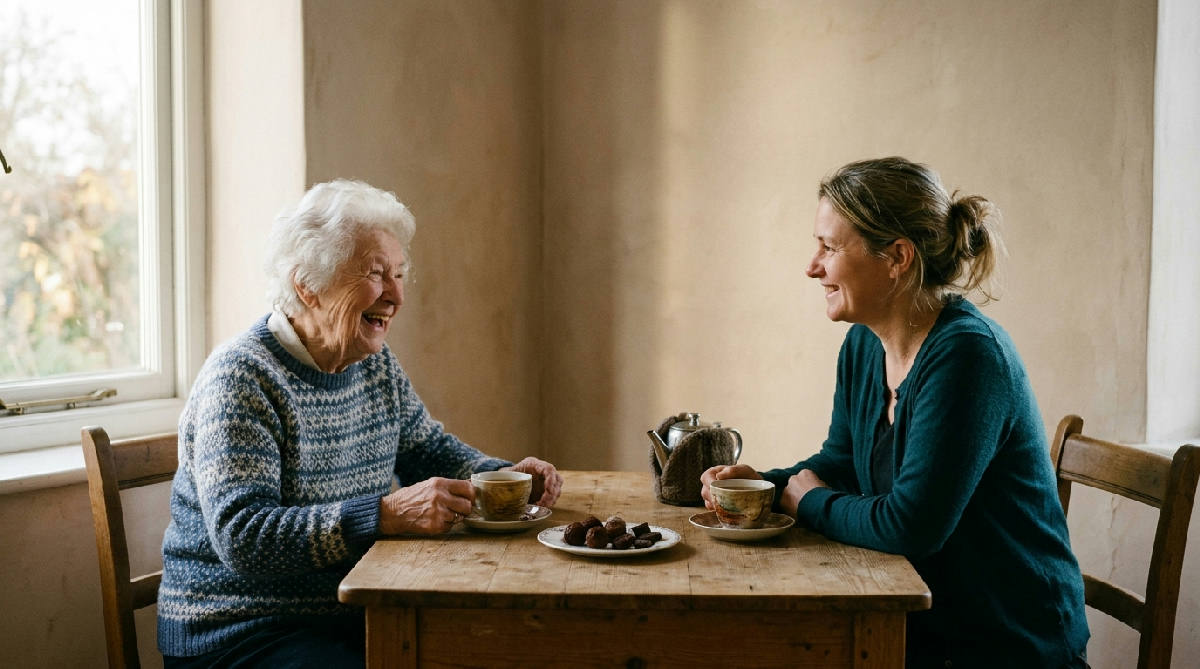
Most of us have felt it. The last day of a trip tastes sweeter. The last song of the night sounds better. The last hug at the airport lasts a little longer.
Two psychologists wanted to know whether that feeling was real, so they tested it with **the simplest thing they could think of: a bag of chocolates.**
What they found is small, and a little funny. It also says something about the moments in a family that **nobody tells us are the last.**
1. Five chocolates, and one sentence that changed
Fifty-two students took part in what they were told was a taste test of Hershey's Kisses. Five chocolates came out of a bag one at a time, in random order, and **nobody knew how many there would be.** After each one, they rated how much they enjoyed it.
Half the group heard "Here is the next one" before every chocolate. The other half heard the same thing, until the fifth. That one came with a different line: **"This is the last one."
Nothing about the chocolate changed. Only what people were told about it.
2. The one called last became the favorite
When the fifth chocolate was called the last, people rated it more enjoyable, and **picked it as their favorite 64 percent of the time,** whatever flavor it happened to be. In the group told only "next," the fifth was the favorite 22 percent of the time, about what chance would predict.
The "last" group also **rated the whole tasting as more enjoyable.** "When you simply tell people something is the last, they may like that thing more," O'Brien said. He described the pull as motivational, a wish to get the most out of something while you still can.
Knowing it is the last makes people lean in.
3. Most of the real lasts never get a label
Here we want to be careful. **This was a small study of students tasting chocolate, not a study of families.** What follows is our own reading, not a finding.
In the study, someone announced the last one. Life rarely does. The last time a parent tells a certain story at the table, the last Sunday call that runs long, the last time a voice explains how something was done: **those usually pass as just another "next one."** If knowing makes us savor, then the moments worth savoring most are the ones we are least likely to recognize while they are happening. The only way around that is to treat the ordinary ones as if they count.
You rarely get told which time is the last, so it pays to listen as if you were.
When you simply tell people something is the last, they may like that thing more.Ed O'Brien, on O'Brien and Ellsworth (2012), Psychological Science, 23(2), 163 to 165
What you get with LifeScribe
- A 2012 study in Psychological Science tested how the word "last" changes enjoyment.
- 52 students tasted five chocolates, with the fifth called either "the next one" or "the last one."
- Called the last, it was the favorite 64 percent of the time, against 22 percent when called the next.
- Built on documented research: O'Brien and Ellsworth, Psychological Science, 2012.
Start free, with nothing to lose
You do not need to know which time is the last. Just a phone call, free. Ari asks the questions and keeps the answers in their own voice, so the ordinary stories are kept before anyone has to call them the last.
Nobody stands at the kitchen table and announces the last time a story will be told. It just passes, like any other evening. The voice that told it is the part you cannot get back later.
Keep the stories before anyone calls them the last.
Ari calls and listens, so the everyday stories are kept in their own voice for the people you love.
Questions grandparents ask us
What did the study actually find?
In a 2012 study in Psychological Science, Ed O'Brien and Phoebe Ellsworth found that a chocolate introduced as "the last one" was enjoyed more, and was picked as the favorite 64 percent of the time, compared with 22 percent when it was introduced as "the next one."
Who took part?
52 students, women and men, in a taste test of five Hershey's Kisses. They did not know in advance how many chocolates there would be.
Why would the word "last" matter?
The researchers described it as motivational: when people know something is ending, they want to get the most out of it while they still can.
Does the study say anything about families?
No. It tested chocolates and students. The idea that the real lasts in a family usually come without a label is our own reading, not a finding of the study.