A researcher spent years writing down what people said right before they laughed.
A Researcher Listened In on 1,200 Laughs in Malls and Other Public Places. Most Came After Lines Like "I See Your Point."
Robert Provine collected 1,200 laughs overheard in malls and other public places. Most of them did not follow a joke. They followed lines like "I see your point" and "It must be nice."
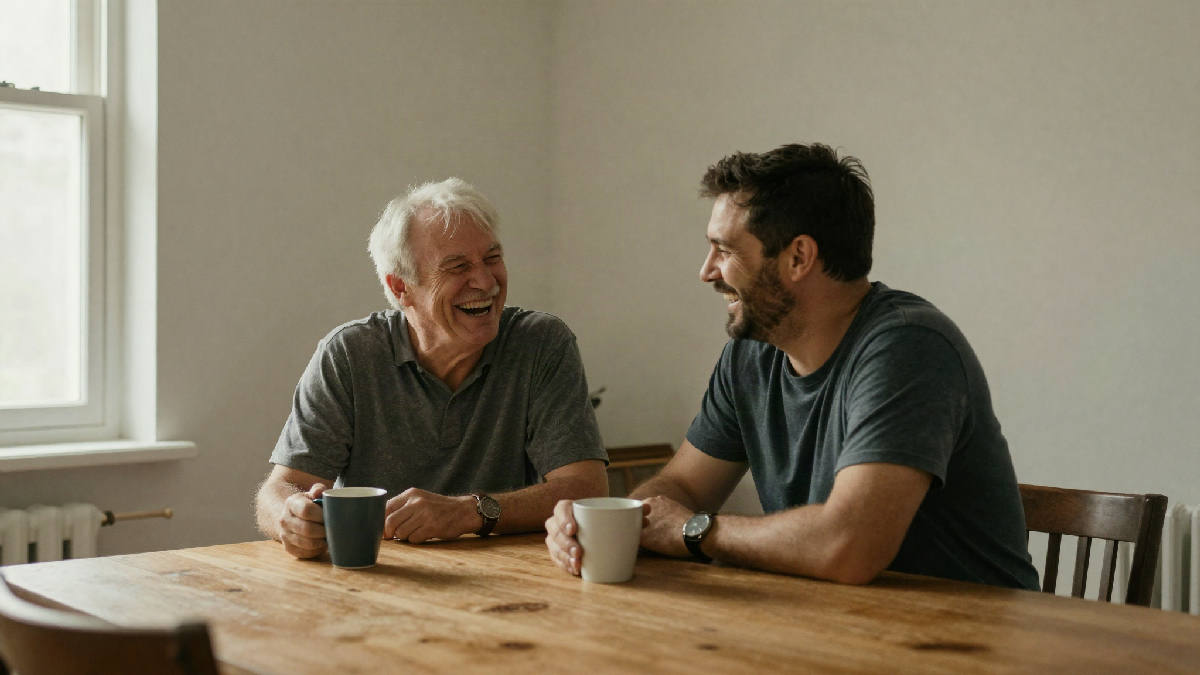
We think of laughter as something a joke earns. **A punchline. A funny story. A good comeback.**
A neuroscientist named Robert Provine went out to check. **He listened in on ordinary people in ordinary places, and wrote down what came right before each laugh.**
What he found is that **most laughing has very little to do with being funny.** It is part of how people talk to each other.
1. 1,200 laughs, written down one by one
Provine and his students went to **shopping malls and other public places** and quietly listened to people talking. Each time someone laughed, they noted **what had just been said, who said it, and who laughed.**
Over time they gathered **1,200 of these laughs.** He reported the work in the journal *Ethology* in 1993 and summed it up for general readers in *American Scientist* in 1996.
Not a lab. Not a comedy club. Just people talking.
2. The lines before the laughs were ordinary
The researchers were surprised by **how plain the comments before a laugh usually were.** Lines like **"Got to go now!", "I see your point." and "It must be nice."**
**Most of the laughs did not follow anything that would count as a joke.** They followed the small, everyday back and forth of people who were glad to be talking.
Laughter mostly lives in plain conversation, not in punchlines.
3. The person talking laughed the most
You might expect the listener to do the laughing. **It went the other way. On average, the person speaking laughed about 46 percent more often than the people listening.**
So **the laugh you remember from someone is often their own,** the one that breaks into their sentence while they are telling you something.
A laugh is usually part of the telling, not just a reaction to it.
4. What this might mean for the voices in your family
We want to be careful here. **Provine studied strangers in public places. He did not study families, parents or recordings.** The numbers on this page come from published summaries of his work, and what follows is our own reading, not a finding.
If laughter lives in ordinary talk, then **the laugh you will miss most is not on any video of a party.** It is the one in the middle of a story about the first car, or the neighbor, or the job they hated. **A photograph cannot keep it. A conversation can.** And the best way to hear it is to get them talking about their life.
Get them telling it. The laugh comes with the story.
They were startled by the ordinariness of the comments that would elicit laughter.Deseret News (1997), describing Robert Provine's laughter research
What you get with LifeScribe
- Robert Provine recorded 1,200 laughs overheard in malls and other public places.
- Most of them followed ordinary remarks, not jokes.
- The person speaking laughed about 46 percent more often than the people listening.
- Built on documented research: Provine, Ethology, 1993, and American Scientist, 1996.
Start free, with nothing to lose
You do not need a camera or a recorder. Just a phone call, free. Call Ari, and she asks about their life, listens, and keeps every word in their own voice, laugh included.
The laugh you know best is the one that breaks into their stories. It only shows up when they are talking. Give them a reason to talk this week.
Keep the laugh, not just the photo.
One phone call with Ari, and the stories only they remember are saved in the voice of the person who lived them.
Questions grandparents ask us
What did Provine's study find?
Robert Provine and his students wrote down 1,200 episodes of laughter overheard in malls and other public places, noting what was said just before each one. Most laughs followed ordinary remarks rather than jokes, and the person speaking laughed about 46 percent more often than the people listening.
Where was the research published?
Provine reported the work in the journal Ethology in 1993 (volume 95, pages 291 to 298) and summarized his laughter research for general readers in American Scientist in 1996. The figures on this page come from published summaries of that work, not from the full paper.
Were there exceptions?
The pattern varied with who was talking to whom. Later researchers have also questioned parts of Provine's account, such as how often laughter overlaps speech. The broad finding, that most everyday laughter is not a response to jokes, is the part this page relies on.
Does this research say anything about families?
No. Provine studied strangers in public places. The idea that a parent's laugh is best kept by getting them to talk about their life is our own reading, not a finding of the research.
https://getlifescribeapp.com/blog/the-laugh-after-the-ordinary-line