A name can go missing. A face can stop registering. One kind of memory keeps answering back.
A Neuroscientist Found the One Memory Alzheimer's Struggles to Erase. It Is Not a Name. It Is a Song.
Petr Janata's 2009 brain imaging study at UC Davis found that a familiar song activates the same brain region that stores your sense of who you are, and that region tends to be one of the last places Alzheimer's disease reaches. The song is not the whole story, though. It is just proof the person telling it is still in there.
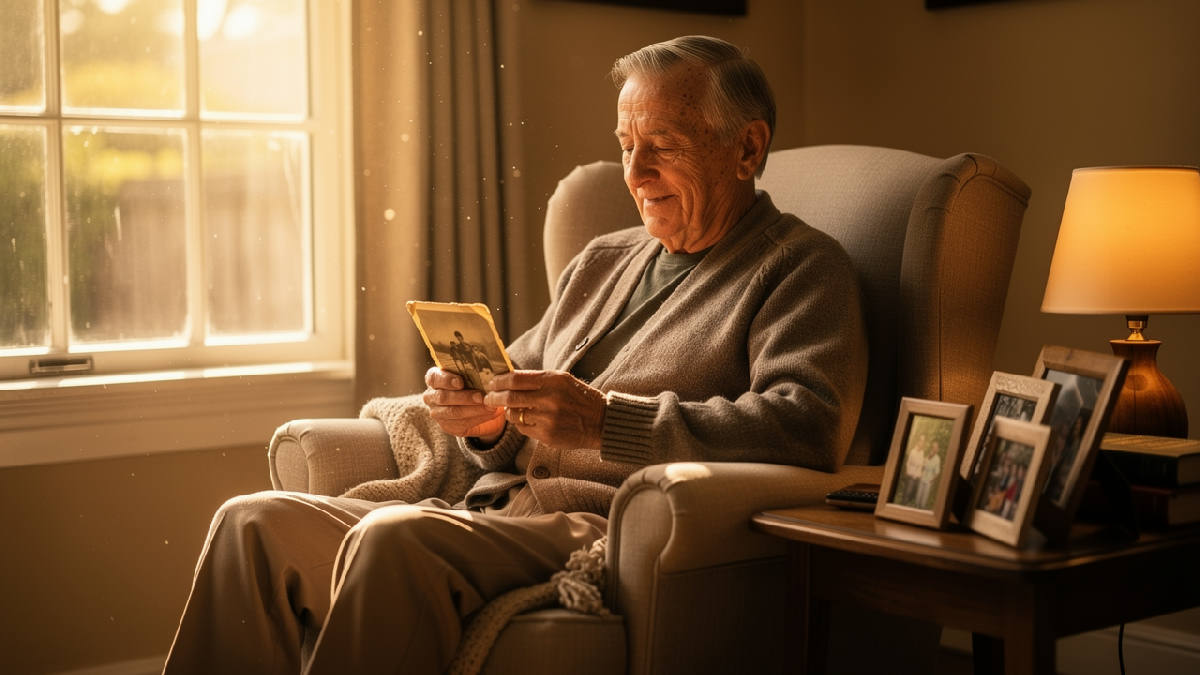
Play someone with advanced Alzheimer's a song from when they were seventeen, and something can happen that nothing else in the room manages anymore. **A blank expression sharpens. A hand starts keeping time. Sometimes the words come back before anything else has, in years.** It looks like a small miracle. It is closer to a wiring diagram.
Petr Janata's 2009 study, published in the journal *Cerebral Cortex*, used brain imaging to trace what happens when familiar music plays. **He found that a region called the medial prefrontal cortex lights up in step with how personally meaningful a song is**, and that same region is where the brain appears to file autobiographical memory, the sense of your own life as a continuous story. It is one of the areas Alzheimer's disease is slowest to damage.
That finding is why the nonprofit Music & Memory, started by Dan Cohen in 2010 and later featured in the documentary *Alive Inside*, has spent years handing personalized playlists to nursing home residents who had stopped responding to almost everything else. **The song can reach someone the rest of the day cannot.** But a song was never going to tell you what they were thinking, who they loved first, or what they wanted you to know. Only their own voice can do that, and only while there is still time to ask.
1. The room in the brain music almost never leaves
Most of what Alzheimer's takes, it takes from the outside in: recent conversations first, then names, then faces that used to be automatic. **The medial prefrontal cortex sits differently. It is where a life gets filed as a story instead of a list of facts**, and Janata's imaging showed it responds to music with the same signature it uses for a real, personally meaningful memory.
That is not the same as saying music cures anything. **It means the wiring that ties a song to the person you actually are is built to be durable**, and disease reaches it later than it reaches almost everything else in a damaged brain.
The brain files music next to identity, not next to trivia. That is why it survives longer than almost anything else.
2. A song can bring someone back. It cannot tell you what they know
Watch the footage from a Music & Memory session and it is easy to mistake the moment for the whole story returning. **It is not. It is recognition, a flicker of the person surfacing, not the story itself.** The song cannot tell you what your grandfather was actually thinking the day he shipped out, or what your mother almost named you before she changed her mind.
Only the person can hand you that, in their own words, while enough of the story is still reachable to tell. **The window where music still works is also the window where a real conversation still works, and it does not stay open at the same width forever.**
A song proves someone is still in there. Only their own voice can tell you what they know.
3. Call while the story is still reachable, not after
You do not need a diagnosis, a special occasion, or a formal interview to start. **You need one ordinary phone call, and a question worth asking.** With LifeScribe, Ari asks a real question and lets your parent or grandparent answer in their own words, then keeps that answer in their actual voice, not a secondhand summary written down later.
**The song will likely outlast a lot of what makes them who they are. Their own voice, telling their own story, does not have to wait to find out how much time is left.** Ask now, while the answer is still theirs to give.
Do not wait for a reason. The story is more reachable today than it will be later.
My grandmother has good days and hard days now. On a good day last spring I called just to talk, and Ari asked her what her own mother used to sing while she cooked. She sang four lines of it, then told me a story about a kitchen I never knew existed. I have the whole thing in her voice. On the hard days now, I play it back before I call, so I remember who I am talking to.Renata, 41, recording her grandmother's memories on ordinary phone calls
What you get with LifeScribe
- No diagnosis, occasion, or formal interview required, just the next ordinary phone call with the person you already talk to.
- Ari asks a real question and lets your parent or grandparent answer in their own words, at their own pace.
- What gets kept is their actual voice telling their actual story, not a secondhand summary written down after the fact.
- Built around documented science: the memory tied to identity is one of the last a fading brain lets go of, and it is worth reaching while more of the story is still theirs to tell.
Start free, with nothing to lose
Try it on the next call, free. Nothing to install, nothing to schedule around. If it does not feel like it kept something real, you have lost nothing but a few minutes of a call you were already going to have.
**The song may outlast the story. That is not a reason to wait, it is the reason not to.** The window where a real conversation still works is the same window where music still works, and it narrows before anyone gets a clear warning.
Their voice can still tell you what a song cannot.
Let Ari ask the question on your next ordinary call, and keep the answer in their own words before that becomes harder to reach.
Questions grandparents ask us
Is it true that music memory survives longer in Alzheimer's disease?
Research points that way. Petr Janata's 2009 study in the journal Cerebral Cortex, conducted at UC Davis, found that the medial prefrontal cortex, a region tied to autobiographical memory and personal identity, responds strongly to personally meaningful music, and this region tends to be affected later in Alzheimer's disease than the areas that handle recent memory and recognition.
What is the Music & Memory program?
It is a nonprofit started by Dan Cohen in 2010 that provides personalized music playlists to people in nursing homes and dementia care, often on simple MP3 players. It was featured in the documentary Alive Inside, which showed residents responding to familiar songs after long periods of limited engagement with anything else.
Does this mean music can reverse memory loss?
No. Music does not restore memories that have been lost, and it is not a treatment for the underlying disease. What the research shows is that recognition of personally meaningful music can persist longer than other kinds of memory, which is different from recovering memories that are already gone.
Why does LifeScribe focus on capturing someone's voice now instead of relying on music later?
A familiar song can bring a flicker of recognition, but it cannot tell you what a person actually thought, felt, or wanted you to know. That only comes from their own words. Ari helps capture those words during an ordinary phone call, while more of the story is still reachable to tell.
What happens to what gets recorded?
Each story becomes a keepsake your family can read and listen to later, in the person's own voice, so a phone call that would have just ended becomes something you actually kept.
https://getlifescribeapp.com/blog/the-one-memory-alzheimers-struggles-to-erase