Sometimes the help is a voice on the line.
Researchers Had Volunteers Phone 240 Isolated Adults for Four Weeks. They Only Listened. Loneliness Dropped.
Researchers randomly assigned 240 adults, most of them older and homebound, to get friendly calls from trained volunteers or none. Four weeks later, the people who got the calls felt less alone.
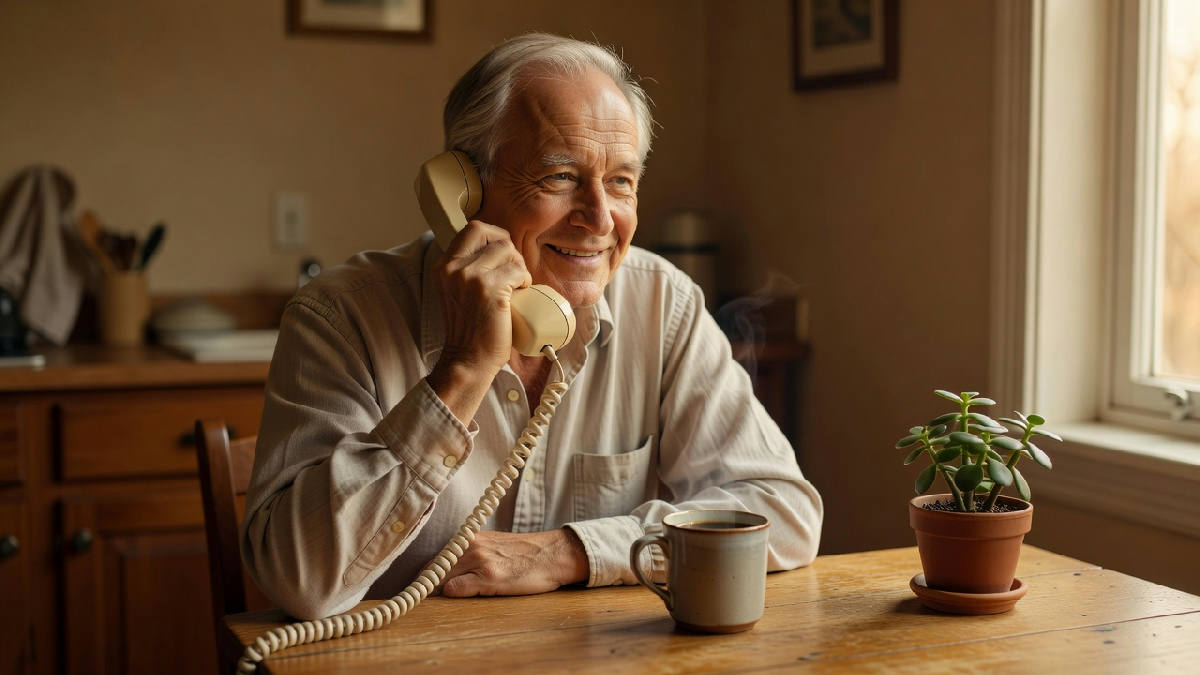
It is easy to think a **lonely person needs a big fix.** This study tested something smaller: **a phone call from someone who listens.**
In 2021, **Mohit Kahlon and colleagues** published a trial in **JAMA Psychiatry.** They enrolled **240 adults** who were clients of a meal delivery program in Central Texas, and **randomly assigned** them to **receive calls** or **receive none.**
It was not a study about life stories or families. But it is one of the clearest tests of a simple idea: **being listened to, by voice, can change how a person feels.**
1. What the researchers did
The **240 adults** were aged **27 to 101,** and about **63% were 65 or older.** More than half **lived alone,** and all reported at least **one chronic condition.**
Sixteen **young volunteer callers** got a short training in **warm, empathetic conversation.** Each phoned **six to nine people** over **four weeks,** daily for the first five days, then at least **twice a week** if the person wanted fewer calls. The other group got **no calls.**
Trained volunteers, a phone, and four weeks of conversation.
2. What changed
After four weeks, the group that got calls scored **1.1 points better on a loneliness scale** than the group that did not (a scale running from 3 to 9). They also scored better on **depression** (1.5 points) and **anxiety** (1.8 points).
A second loneliness measure moved in the same direction but **did not reach the usual threshold** for statistical significance. **General physical health did not change.**
Less lonely, less low, less anxious. Physical health did not budge.
3. What it can and cannot tell us
This was a trial of **trained volunteers calling at-risk adults.** It did **not test recordings, family stories or Ari.** The authors also said it is not yet clear whether the effect on depression and anxiety can be stretched into something lasting.
What it gently suggests is simple: **a voice that listens with real interest matters.** If someone you love has stories only they can tell, **a call where someone truly listens** may be the best way to hear them. It is just a phone call.
Being listened to is not small.
A layperson-delivered, empathy-oriented telephone call program reduced loneliness, depression, and anxiety compared with the control group.Kahlon and colleagues, JAMA Psychiatry, 2021 (from the paper's abstract)
What you get with LifeScribe
- A 2021 JAMA Psychiatry trial by Kahlon and colleagues randomly assigned 240 adults to receive phone calls or no calls.
- Participants were clients of a meal delivery program in Central Texas, aged 27 to 101, 63% aged 65 or older.
- Trained volunteers phoned each person for four weeks.
- The calls group improved by 1.1 points on a 3 to 9 loneliness scale, 1.5 points on depression and 1.8 points on anxiety.
- A second loneliness scale moved in the same direction but did not reach the usual significance threshold, and physical health did not change.
- It tested volunteer calls, not recordings, family stories or Ari.
- Built on documented research: JAMA Psychiatry 78(6), 616 to 622, DOI 10.1001/jamapsychiatry.2021.0113.
Start free, with nothing to lose
Just a phone call, free. Ari listens with real interest and keeps your stories in your own voice for the people you love.
The stories are still in the people who lived them. A call where someone listens is how they get told. It is just a phone call.
Let someone you love be listened to.
Ari calls, asks about the people and moments that shaped you, and keeps your stories in your own voice for the people you love.
Questions grandparents ask us
What did the study find?
Adults who got four weeks of friendly calls from trained volunteers reported less loneliness, depression and anxiety than adults who got none.
Who ran it?
Mohit Kahlon and colleagues, published in JAMA Psychiatry in 2021.
How many people were involved?
240 adults, randomly assigned to receive calls or no calls.
Was every result clear?
No. One loneliness scale improved clearly, a second moved the same way without reaching the usual threshold, and physical health did not change.
Did it study life stories or families?
No. It tested volunteer phone calls. This page makes no claim that it applies to recordings or family stories.
Why does it matter for a life story?
It suggests a voice that listens with real interest can matter to a person, which is the spirit of a conversation where a story gets told.
https://getlifescribeapp.com/blog/the-phone-calls-that-eased-loneliness