Looking back is not one thing. Why you do it changes what it does for you.
Researchers Reviewed Why People Look Back Out Loud. Telling It to Teach and to Know Who You Are Helped. Telling It to Revive Old Bitterness Did Not.
In a 2010 review, Gerben Westerhof, Ernst Bohlmeijer and Jeffrey Dean Webster sorted the reasons people reminisce, and asked which ones help.
Think of the last time you told someone a story from your past. **Why did you tell it?** To make them laugh, to pass something on, to remember who you were, or because an old hurt would not let go.
A review in the journal *Ageing & Society* argues that these reasons are **not the same, and they do not do the same thing.** The authors describe **three kinds** of reminiscence, and the effects differ for each.
It was a review of earlier studies, not a test of recorded stories. Still, it carries a gentle idea: **the way you look back matters as much as the fact that you do.**
1. Telling it to teach is a social act
The authors describe a **social** kind of reminiscence. They write that using personal recollections **to teach and inform others** has social functions: **sharing memories builds connection** and passes lessons forward.
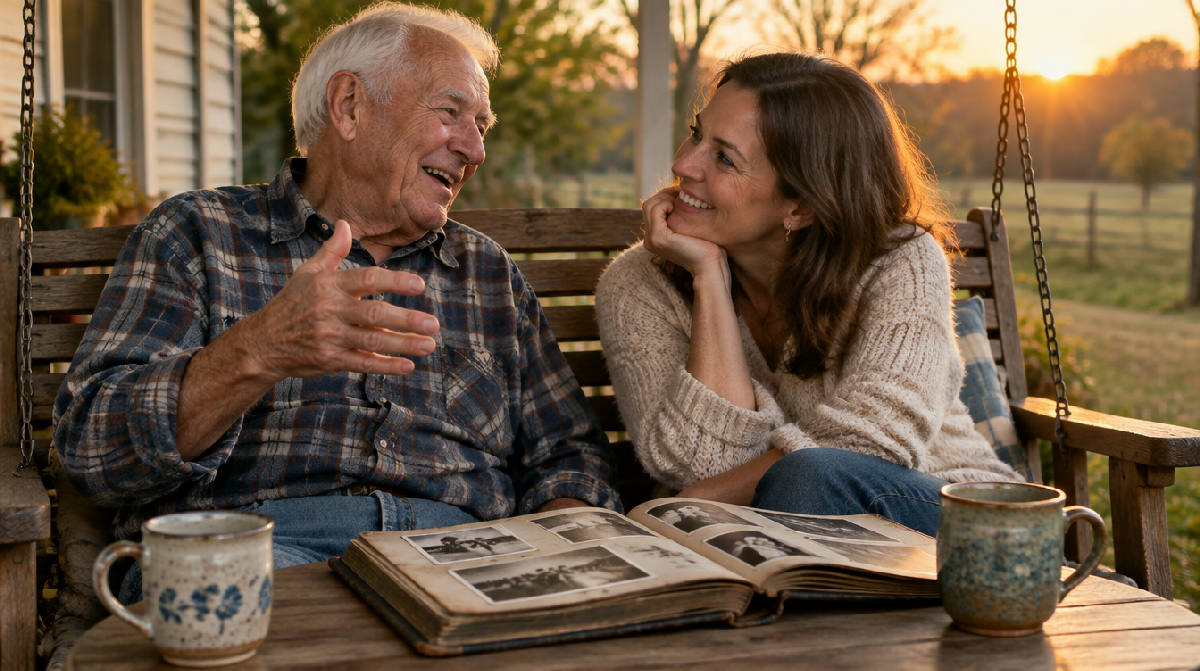
This is the kind that happens on a porch, at a kitchen table, or on a phone call, when someone says *let me tell you what happened to me.*
A story told to someone is a gift with a reader. That is part of what makes it work.
2. Telling it to know who you are helps too
The second kind is **positive and self-focused.** The abstract says its functions include **the integration of memories into identity**, and the authors also name using the past to solve problems and to prepare for the end of life.
They suggest that a method called **life review** draws on these positive functions to support well-being.
Looking back to find the thread of your life is different from simply replaying it.
3. Looking back to revive bitterness is the one to watch
The third kind is **negative and self-focused.** The authors list **reducing boredom** and **reviving bitterness** among its functions, and propose a more careful, therapeutic form of life review for people who get stuck there.
This was a **review of earlier work**, not a new experiment, and it **did not test recorded stories.** We read the published abstract, not the full paper, so this page states **nothing more than the abstract supports.**
The point is not to avoid the past. It is to look at it in a way that gives something back.
Positive functions for the self include the integration of memories into identity.Westerhof, Bohlmeijer and Webster, Ageing & Society, 2010, from the journal abstract
What you get with LifeScribe
- A 2010 review in Ageing & Society by Westerhof, Bohlmeijer and Webster looked at recent progress in the theory and research of reminiscence.
- It describes three kinds of reminiscence: social, positive self-focused, and negative self-focused.
- Teaching and informing others is described as a social function.
- Integrating memories into identity is described as a positive function for the self.
- Reviving bitterness is described as a negative function.
- Built on documented research: Ageing & Society, 30(4), 697 to 721, 2010.
Start free, with nothing to lose
Just a phone call, free. Ari listens with real interest, asks about the moments that shaped you, and keeps your stories in your own voice for the people you love.
The stories only get told once the telling begins. Tell yours while you can, in your own voice, to someone who will listen. It is just a phone call.
Tell it to someone who is listening.
Ari calls, asks about the moments that shaped you, and keeps your stories in your own voice for the people you love.
Questions grandparents ask us
What did the review find?
It describes three kinds of reminiscence, social, positive self-focused and negative self-focused, and suggests that different approaches fit each one.
Who wrote it?
Gerben J. Westerhof, Ernst Bohlmeijer and Jeffrey Dean Webster, published in Ageing & Society, volume 30, issue 4, pages 697 to 721, in 2010.
Was it a new experiment?
No. It is a review of recent theory, research and interventions. We read the published abstract, not the full paper, so this page says nothing more.
Did it study recorded stories?
No. This page makes no claim that it applies to recordings or to families.
Why does it matter for a life story?
It suggests that telling a story to teach or to understand yourself is a different act from replaying an old hurt. Telling it in your own voice, to people you love, leans toward the first.