The story they have heard before may be the one they want most.
Researchers Had People Retell a Story to Friends. The Friends Who Already Knew It Enjoyed It Far More, and the Tellers Did Not See That Coming.
In a 2017 paper in Psychological Science, Gus Cooney, Daniel Gilbert and Timothy Wilson found that people guess wrong about which stories their listeners enjoy.
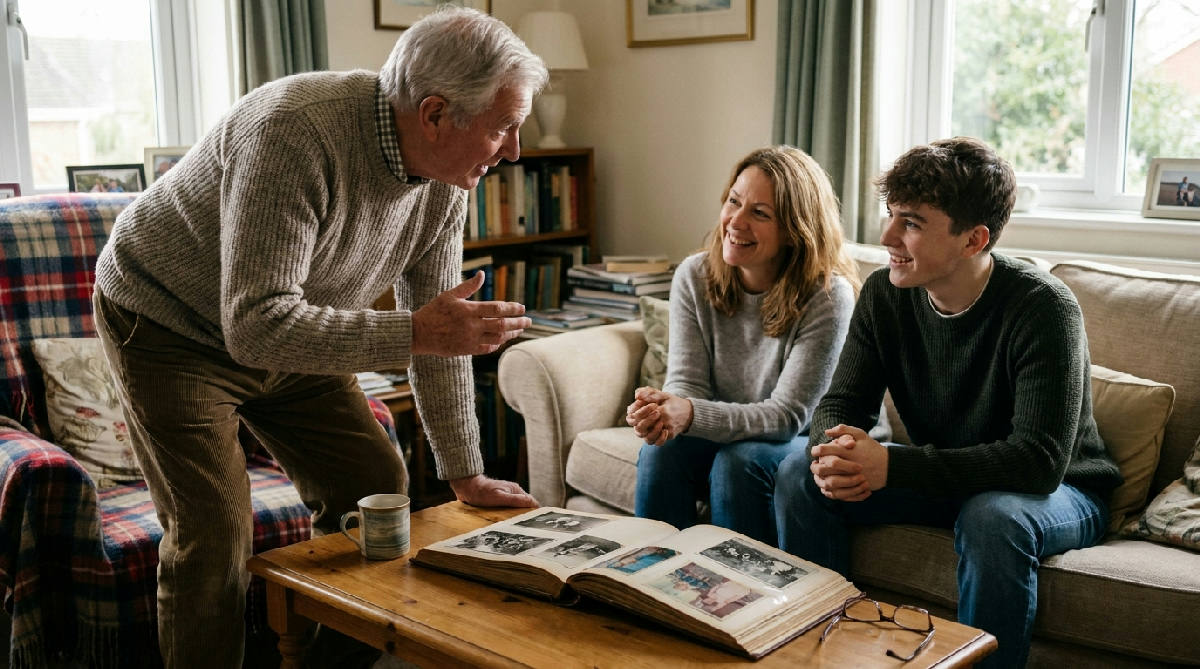
Most of us hold back the old stories. We figure the family has **heard them already,** so we look for something new to say.
Harvard and University of Virginia researchers tested that instinct in four experiments. People who told stories **expected listeners to prefer something new.** The listeners said the opposite.
It was a lab study of strangers and videos, not families. Still, it points at something worth knowing: **the story you think is worn out may be the one they most enjoy hearing.**
1. Speakers bet on new. Listeners preferred familiar.
In the first experiment, people formed groups of three: **one speaker and two listeners.** Speakers watched either a TED talk about crow intelligence or an interview with the owner of a specialty soda shop, then described it. Some listeners had **seen the same video.** Others had not.
Speakers predicted that listeners who had not seen it would enjoy the story more. In fact, listeners who **had already seen it** responded more positively. The paper reports that listeners made the same wrong guess when they predicted their own reaction (Studies 1 and 2).
Both sides expected novelty to win. It did not.
2. The old story was not told better. It was easier to follow.
The researchers checked whether familiar stories simply came out **better told.** They did not find that. The gap was not explained by differences in the content or delivery of the two kinds of story (Study 3).
Their explanation is about **gaps.** Tellers leave things out, and listeners who already know the material can **fill in the gaps with what they know** (Study 4). Daniel Gilbert put it this way: **"We worry too much about thrilling our listeners and not enough about confusing them."**
A listener with some background can follow a story that a stranger would struggle with.
3. Here is the honest part: this was a lab, not a family
The experiments used **two videos** and strangers brought together for the study. The press summaries we could read give **no sample sizes,** so this page states none.
It did not test families, grandparents, phone calls or recorded stories. What it offers is a **useful nudge:** when you doubt that anyone wants the story again, remember that the people guessing in this study were wrong in a very consistent way.
A small lab finding, honestly limited, and still a reason to tell it once more.
We worry too much about thrilling our listeners and not enough about confusing them.Daniel T. Gilbert, Harvard University, in the Association for Psychological Science release on the 2017 study
What you get with LifeScribe
- A 2017 paper in Psychological Science ran four experiments on telling and hearing stories.
- Speakers expected listeners to enjoy new stories more. Listeners enjoyed familiar ones more.
- Listeners made the same wrong prediction about their own reactions.
- The researchers suggest familiar stories let listeners fill in the gaps with what they already know.
- The study used strangers and two videos, and did not test families or recorded stories.
- Built on documented research: Cooney, Gilbert and Wilson, Psychological Science, 28(3), 380 to 394, 2017.
Start free, with nothing to lose
Just a phone call, free. Ari listens, asks about your life, and keeps your stories in your own voice for the people you love.
The stories your family has heard before are the ones they can follow best, and the ones they will miss most. Told in your own voice, they stay. It is just a phone call.
Tell the one they have heard before.
Ari calls, listens, asks what came next, and keeps your stories in your own voice for the people you love.
Questions grandparents ask us
What did the study actually find?
In a 2017 paper in Psychological Science, speakers and listeners both predicted that listeners would enjoy new stories more. Listeners actually enjoyed familiar stories more.
Who ran it?
Gus Cooney and Daniel Gilbert of Harvard University and Timothy Wilson of the University of Virginia, published in Psychological Science, volume 28, pages 380 to 394, in 2017.
Why would a familiar story be more enjoyable?
The authors point to gaps. Tellers leave things out, and listeners who already know the material can fill them in.
Did it study families or recorded stories?
No. It used groups of strangers and two videos. This page makes no claim that recording a story changes anything about how your family hears it.
Why does it matter for a life story?
It suggests that doubting whether anyone wants an old story again may be a bad guess. Telling it in your own words keeps your version for your family.
https://getlifescribeapp.com/blog/the-story-they-already-knew