The obvious cure for feeling short on time is more free time. Four experiments found something that worked better.
Researchers Had Busy People Spend a Few Minutes on Someone Else. Afterward, They Felt Like They Had More Time, Not Less.
In a 2012 study in Psychological Science, Cassie Mogilner, Zoe Chance and Michael Norton found that spending time on other people left people feeling more time affluent than any of the alternatives they tested.
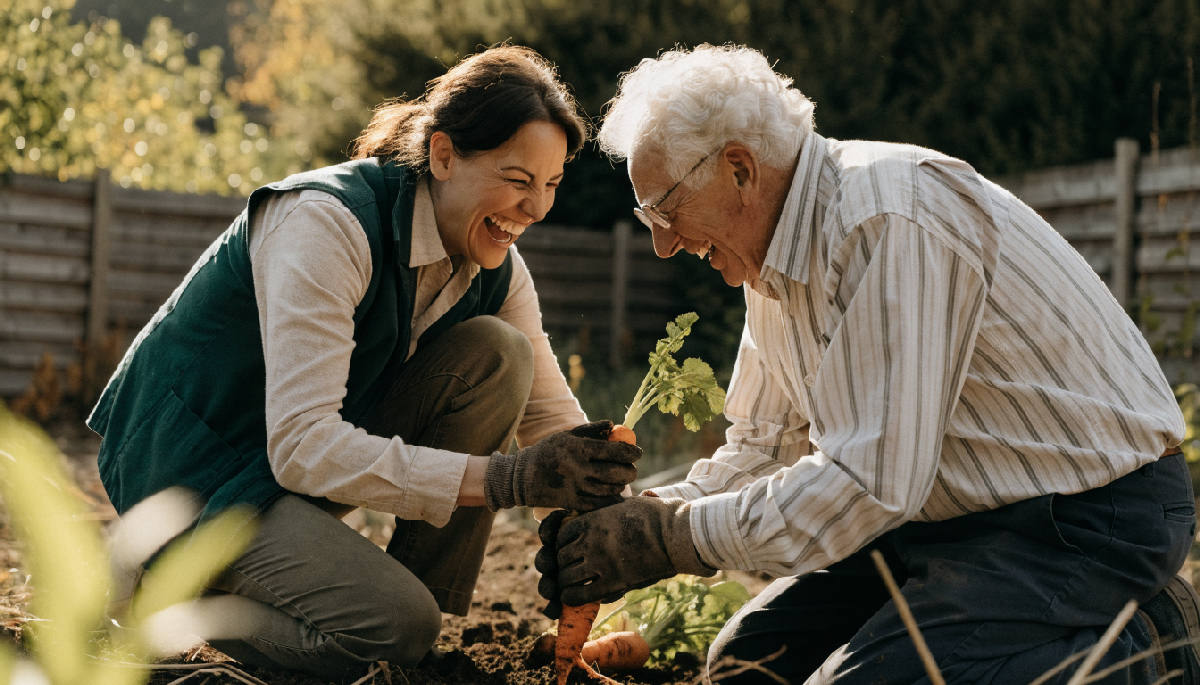
Almost everyone says it. **There is never enough time.** Not for the call, not for the visit, not for the question you keep meaning to ask.
Three researchers wanted to know whether that feeling could be changed. Nobody can add hours to a day, so they tested something else: **what happens to your sense of time when you give some of it away?**
The answer runs against instinct. It also says something about **the time we keep putting off with the people we love.**
1. Four experiments, one question about time
Across four experiments, the researchers compared people who **spent time on someone else** with people who wasted time, people who spent time on themselves, and people who were simply **handed a windfall of free time.**
Then they measured what they called **time affluence:** how much people felt they had time, whatever the clock said.
The hours were the same. The question was how much time people felt they had.
2. Giving it away came out ahead
**Spending time on others increased people's feeling of time affluence,** compared with every other option, including getting free time back. In the paper's own words, the solution to feeling short on time was counterintuitive: **"Give some of it away."**
The researchers traced the effect to a **boosted sense of self-efficacy:** helping someone made people feel capable and effective, and that made their time feel larger. It also made them **more willing to commit to future plans,** despite busy schedules.
Time spent on someone else did not feel like time lost.
3. What this might mean for a phone call you keep postponing
Here we want to be careful. **This study measured short tasks and a feeling of having time. It did not study families, parents, or phone calls.** What follows is our own reading, not a finding.
A lot of us hold off on calling a parent because **we feel we do not have the time.** This research suggests the feeling itself may not be a fixed fact, and that time spent on someone else can leave you feeling less rushed, not more. **Twenty minutes on the phone asking about their life** is time given away, and it may not cost what you think.
The call you are too busy to make may be the one that gives you time back.
Results of four experiments reveal a counterintuitive solution to the common problem of feeling that one does not have enough time: Give some of it away.Mogilner, Chance, and Norton (2012), Psychological Science, 23(10), 1233 to 1238
What you get with LifeScribe
- A 2012 study in Psychological Science tested how spending time affects the feeling of having time.
- Giving time to others was compared with wasting time, spending it on yourself, and getting free time.
- Giving time made people feel they had more time, linked to a boosted sense of being capable.
- Built on documented research: Mogilner, Chance, and Norton, Psychological Science, 2012.
Start free, with nothing to lose
You do not need a free weekend. Just a phone call, free. Ari asks the questions and keeps the answers in their own voice, so the time you give them becomes something the whole family keeps.
There will always be a reason the call can wait. The person on the other end of it will not always be there to pick up. The time you give them now is the part you will never wish you had kept for yourself.
Give them the time. Keep the story.
Ari calls and listens, so the time your family spends talking is kept in the voice of the person who lived it.
Questions grandparents ask us
What did the study actually find?
In four experiments published in Psychological Science in 2012, spending time on other people increased people's feeling of time affluence, the sense of having enough time, compared with wasting time, spending time on oneself, or receiving a windfall of free time.
Why would giving time away make you feel you have more?
The researchers found the effect was driven by a boosted sense of self-efficacy. Helping someone made people feel capable and effective, which made their time feel more expansive.
Who took part?
We have not stated sample sizes or participant details here because we confirmed the findings from the paper's abstract and the Association for Psychological Science release, not the full paper.
Does the study say anything about families or phone calls?
No. It tested short tasks and people's feelings about time. The idea that calling a parent might leave you feeling less rushed is our own reading, not a finding of the study.