When older adults talked about their own lives, they took more side roads. The people listening liked the stories more.
Researchers Had Younger and Older Adults Talk About Their Lives. The Older Ones Wandered Off Topic More, and Listeners Rated Their Stories Better.
In a 1998 paper in Psychology and Aging, Lori James, Deborah Burke, Ayda Austin, and Erika Hulme looked at the long way round, and found it was not the flaw it is often made out to be.
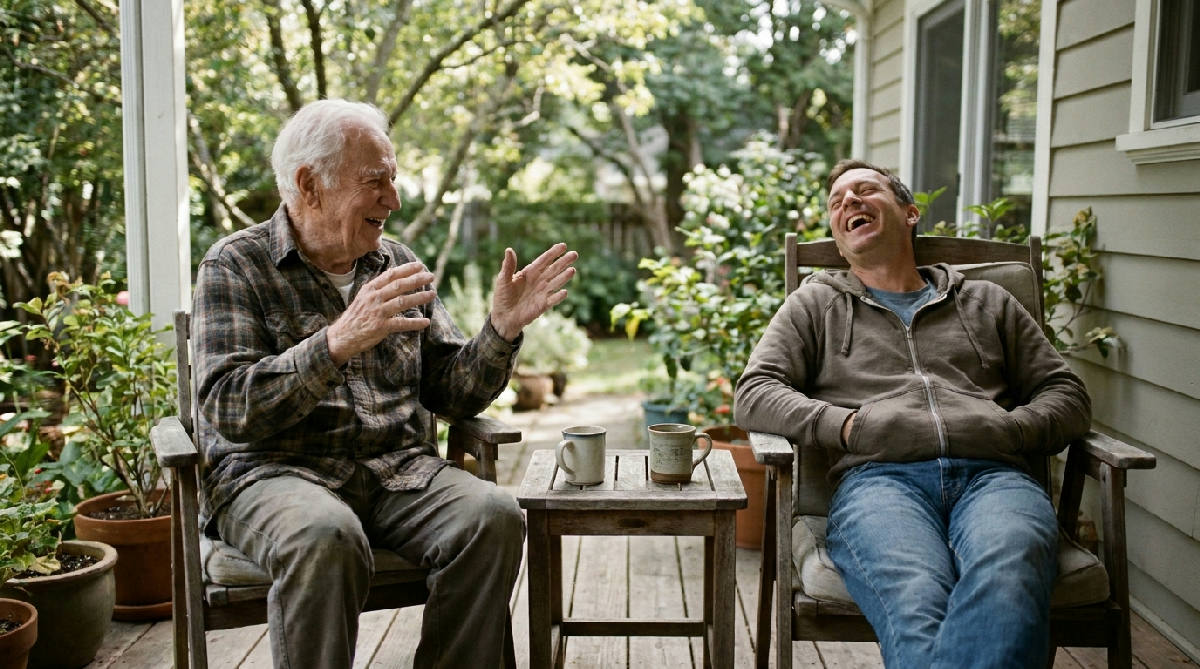
You know the moment. Someone asks your dad a simple question, and ten minutes later he is still on the road there, with a detour through the year the car broke down.
It is easy to hear that as rambling. One study suggests **the people listening may hear something better.**
When researchers compared younger and older adults talking about their own lives, **the older adults wandered off topic more, and their stories were rated as better stories.**
1. More side roads, but only for their own lives
Earlier studies had found that older adults produce more **off-topic speech** in interviews about their lives, and it was usually explained as a slip: trouble filtering out what is not relevant.
James and her colleagues tested it again. Older adults did drift off topic more than younger adults **when talking about their own lives**, but **not when they were simply describing a picture.** So it did not look like a general loss of focus.
The wandering showed up in life stories, not in every task.
2. The listeners liked the older stories more
Then a **second group of younger and older people** rated the stories. They rated the **older adults' story quality more positively** than the younger adults'.
The authors called that a problem for the idea that the extra detail is just a failure to stay on track. They also found that **the age of the person rating** changed how focused the speech seemed, which suggests younger and older listeners judge "off topic" differently.
What looked like rambling to one ear sounded like a better story to another.
3. Telling it for what it meant
The authors read their results as fitting the **Pragmatic Change** idea: as people age, they may tell their stories to **share what the experiences meant**, rather than to be brief.
This was a lab study of speech and ratings. It did not study families, parents, or recorded stories, and the summary we read gives no sample sizes, so hold it lightly. But it is a gentle reason not to hurry someone to the point. **The detour may be the part worth keeping, in their own voice.**
The side roads may be where the meaning lives.
Older adults adopt communicative goals that emphasize the significance of life experiences rather than conciseness in their personal narratives.James, Burke, Austin, and Hulme (1998), Psychology and Aging, describing the Pragmatic Change hypothesis
What you get with LifeScribe
- A 1998 study in Psychology and Aging found older adults produced more off-topic speech than younger adults when talking about their own lives, but not when describing pictures.
- A second group of younger and older raters judged the older adults' story quality more positively.
- The age of the rater changed how focused the speech seemed, which hints that people judge "off topic" differently by age.
- Built on documented research: Lori E. James, Deborah M. Burke, Ayda Aukahi Austin, and Erika Hulme, 1998.
Start free, with nothing to lose
You do not have to write anything. Just a phone call, free. Ari listens for as long as the story takes, so your family hears it in your voice.
The side roads are the first thing a summary leaves out, and the hardest thing to get back. The story told the long way, in their own voice, is the one the people you love will want to hear again.
Let them tell it their way.
Ari calls and listens, with no rush and no word count, so the whole story is kept for the people you love.
Questions grandparents ask us
What did the study find?
Older adults produced more off-topic speech than younger adults when talking about their own lives, but not when describing pictures. A second group of younger and older people rated the older adults' story quality more positively.
Who ran it?
Lori E. James, Deborah M. Burke, Ayda Aukahi Austin, and Erika Hulme. The paper is Production and Perception of "Verbosity" in Younger and Older Adults, Psychology and Aging 13(3), 355 to 367.
Does this mean rambling is always better?
No. It is one study, and the summary we read does not give sample sizes. It suggests the extra detail in life stories is not simply a loss of focus, and that listeners can value it.
Did the study look at families or recordings?
No. It studied speech in interviews and how people rated it. It says nothing directly about parents, grandparents, or recorded stories.
How does LifeScribe fit in?
Ari calls, asks about the moments that mattered, and lets people tell it their own way. Just a phone call, free to start.
https://getlifescribeapp.com/blog/the-long-way-was-the-better-story