The things we keep are rarely just things. They are where the stories live.
Researchers Held 80 Interviews With Older Adults About the Special Things They Planned to Pass On. The Meaning of Each One Was Tied to a Life Story.
In a 2000 study, Linda Price, Eric Arnould and Carolyn Folkman Curasi interviewed older adults about the special possessions they planned to pass on.
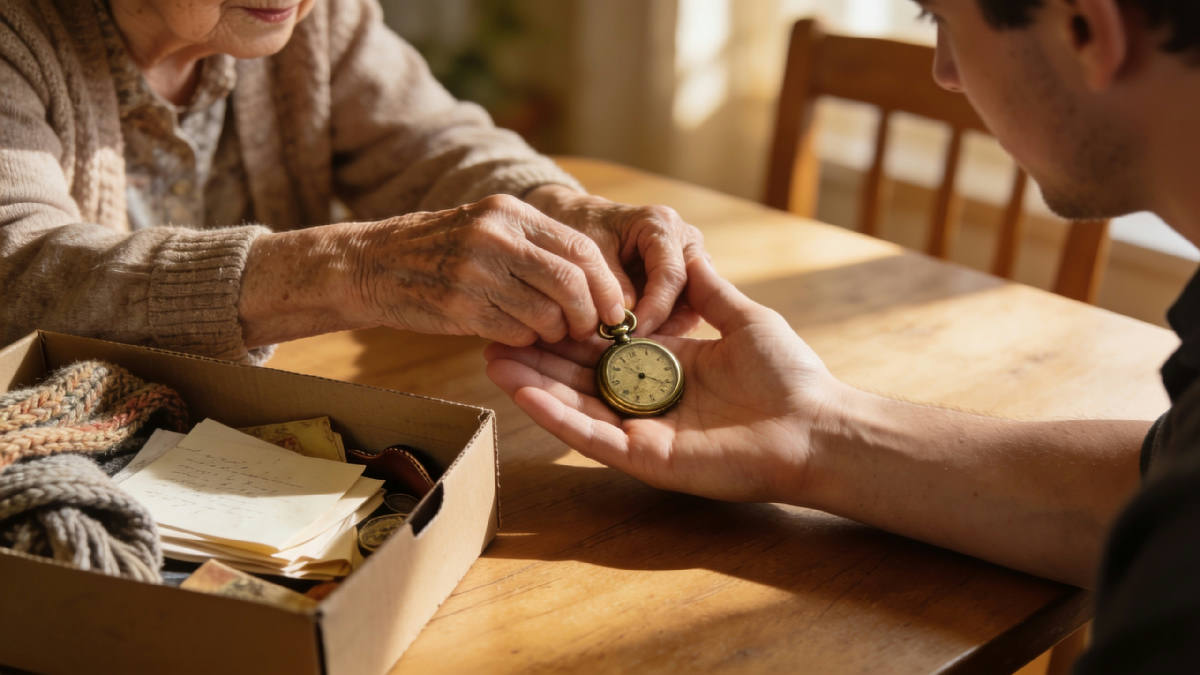
Think of one object in your home that your family would fight to keep. A watch, a brooch, a quilt, a recipe card. **Do they know why it matters?**
Researchers in the *Journal of Consumer Research* interviewed older adults about their most **cherished possessions** and what would happen to them. They found that the meaning of each object was **bound up with a life story.**
It was a study of objects, not of recordings. Still, it points at something simple: **the thing is easy to hand down. The story is the part that can get left behind.**
1. The objects were really stories
The team drew on **80 semistructured interviews** with older consumers, plus **seven longer depth interviews.** The paper reports that cherished possessions play a **significant role in reminiscence and life review.**
The authors stress that the meanings people attach to their special things are **tied to their life stories.** Remove the story and the object is just an object.
A watch tells time. The story of whose watch it was is what a family actually keeps.
2. Deciding who gets what stirred strong feelings
Passing things on was not simple. The authors describe **strong and mixed emotions** around it, and a set of worries: **avoiding conflict in the family,** reducing uncertainty, and keeping some **control over what happens to the object** afterward.
Many people also wanted to shape what their things would **mean** to the next owner. The goals the authors name include **passing on a personal and family legacy** and **making sure a special object finds a good home.**
People were not only deciding where things would go. They were deciding how they would be remembered.
3. The honest part: this was about objects, not recordings
The study was **qualitative.** It reports interviews, not a measured effect, and it **did not test recorded stories** or whether telling the story changes what families do. We read the published abstract, not the full paper, so this page states **nothing more than the abstract supports.**
What it offers is a **gentle prompt.** Pick one thing in your home that carries a story, and **tell the story while you can.**
A small, honest finding and a good question to ask over the next visit.
Cherished possessions and their disposition play a significant role in older consumers' reminiscence and life review.Price, Arnould and Curasi, Journal of Consumer Research, 2000, from the journal abstract
What you get with LifeScribe
- A 2000 paper in the Journal of Consumer Research drew on 80 semistructured interviews and seven depth interviews with older consumers.
- It reports that cherished possessions play a significant role in reminiscence and life review.
- The authors describe meanings attached to objects as bound up with life stories.
- Passing things on raised strong and mixed emotions, and worries about family conflict and control.
- It was a qualitative study of objects, not of recorded stories.
- Built on documented research: Price, Arnould and Curasi, 27(2), 179 to 201, 2000.
Start free, with nothing to lose
Just a phone call, free. Ari listens with real interest, asks about the things you treasure, and keeps your stories in your own voice for the people you love.
The object will outlast the person who knows why it matters. Tell the story behind it while you can, in your own voice. It is just a phone call.
Tell the story behind the thing.
Ari calls, asks about the objects you treasure and where they came from, and keeps your stories in your own voice for the people you love.
Questions grandparents ask us
What did the study actually find?
In a 2000 paper, older adults' cherished possessions were closely tied to their life stories, and decisions about passing them on involved strong, mixed emotions and worries about family conflict and control.
Who ran it?
Linda Price, Eric Arnould and Carolyn Folkman Curasi, published in the Journal of Consumer Research, volume 27, issue 2, pages 179 to 201, September 2000.
How many people took part?
The abstract describes 80 semistructured interviews and seven depth interviews with older consumers. We could not read the full paper, so this page says nothing more about who they were.
Did it study recorded stories?
No. It looked at special possessions and how older adults decide to pass them on. This page makes no claim that it applies to recordings.
Why does it matter for a life story?
It suggests that an object's meaning lives in the story behind it. Telling that story in your own voice gives your family the part of the gift that is easiest to lose.
https://getlifescribeapp.com/blog/the-things-they-meant-to-hand-down