Ask people what they will leave behind, and the answer is rarely the house.
Researchers Asked 14 Adults, Ages 31 to 94, What They Wanted to Leave Behind. Most Named Three Kinds of Legacy, and Ranked What They Believed Over What They Owned.
In 2005, Elizabeth Hunter and Graham Rowles sat down with 14 adults to ask what leaving a legacy really means to them.
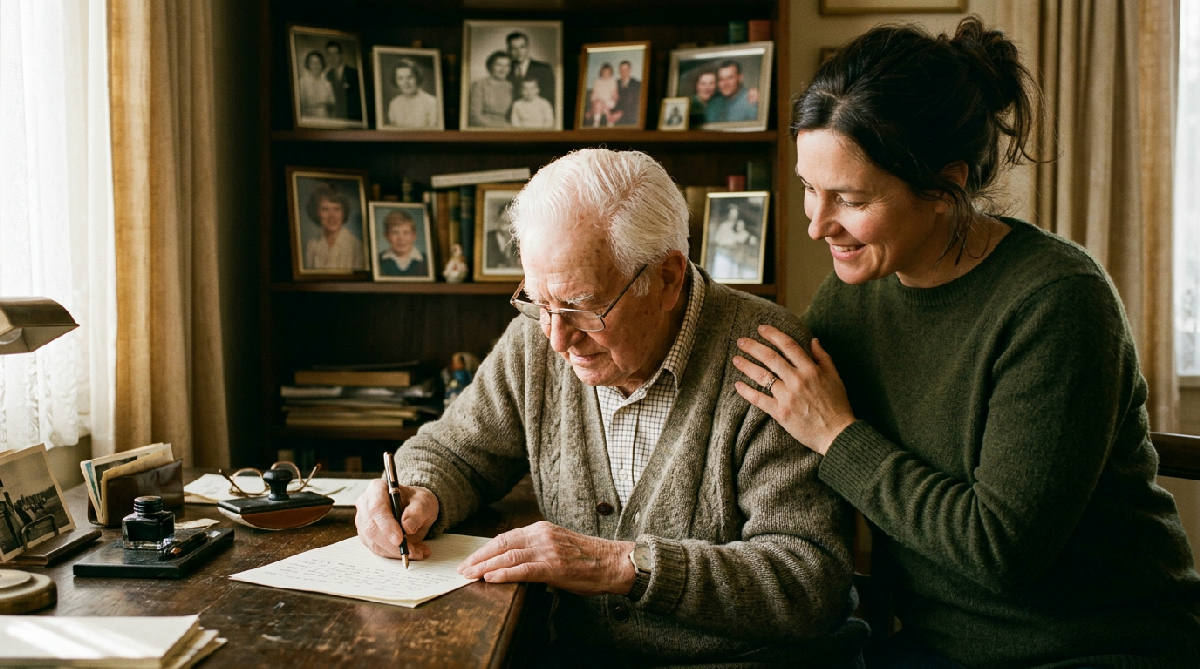
If someone asked what you will leave behind, what would you say first? **The house? The photographs? A name?** Most of us picture things we can hold.
A study in the *Journal of Aging Studies* asked 14 adults, **ages 31 to 94,** the same question in long interviews. It found that legacy comes in **three overlapping kinds,** and that people said **the one they cared about most was not a thing at all.**
It was a small, qualitative study. Still, it gives a plain way to think about what you are really handing down: **what you were, what you owned, and what you believed.**
1. What the researchers did
Elizabeth G. Hunter and Graham D. Rowles held **in-depth interviews with 14 adults** between the ages of **31 and 94,** with a mix of marital, parental and health situations.
Before this, they note, research on legacy had focused almost entirely on **passing along material possessions.** They wanted to hear how people themselves describe it.
They did not hand people a list. They let people say what legacy meant to them.
2. Three kinds of legacy
From the interviews came a typology of **three distinct but overlapping kinds:** a **biological legacy** (the family line), a **material legacy** (the things you own), and a **legacy of values** (what you believe and stand for).
**Most people expressed all three,** in different amounts. But the authors report that the **legacy of values was seen as more important than the other forms.**
The things you own can be listed in a will. The values rarely are.
3. What it can and cannot tell us
This was a **small interview study,** not a measure of how many people feel this way. It **did not test recordings, storytelling, or what families do with a legacy once it is passed on.**
We read the published abstract and a short summary of it, not the full paper, so this page states **nothing more than those support.** What it gently suggests is that **a legacy of values has to be told, because it cannot be handed over like an object.**
A value is easiest to pass on in a story, in your own voice.
The legacy of values was viewed as more important than other forms of legacy.Hunter and Rowles, Journal of Aging Studies, 2005 (paraphrased from the journal abstract)
What you get with LifeScribe
- A 2005 study in the Journal of Aging Studies by Elizabeth Hunter and Graham Rowles interviewed 14 adults ages 31 to 94 about leaving a legacy.
- It described three overlapping kinds: biological legacy, material legacy, and a legacy of values.
- Most participants expressed all three, in varying amounts.
- The legacy of values was viewed as more important than the other forms.
- It was a small interview study and did not test recordings or families passing stories on.
- Built on documented research: Journal of Aging Studies, 19(3), 327 to 347, 2005.
Start free, with nothing to lose
Just a phone call, free. Ari listens with real interest, asks what you believe and why, and keeps your stories in your own voice for the people you love.
Your values are the part of your legacy that only you can say. Say them while you can. It is just a phone call.
Tell them what you stood for.
Ari calls, asks about the lessons, the beliefs and the moments that shaped you, and keeps your stories in your own voice for the people you love.
Questions grandparents ask us
What did the study find?
Interviews with 14 adults found three overlapping kinds of legacy: biological, material, and a legacy of values. Most people expressed all three, and the legacy of values was seen as more important than the other forms.
Who wrote it?
Elizabeth G. Hunter and Graham D. Rowles, published in the Journal of Aging Studies, volume 19, issue 3, pages 327 to 347, in September 2005.
How many people took part?
Fourteen adults, ages 31 to 94, with different marital, parental and health situations.
Did it study recordings or storytelling?
No. It was an interview study about how people describe legacy. This page makes no claim that it applies to recordings, or to what families do with a legacy once it is passed on.
Why does it matter for a life story?
It suggests that what people most want to leave is what they believed, and a belief is easiest to pass on when it is told. Saying it, in your own voice, keeps it from being guessed at later.