The song that comes on may open a story nobody has asked about in years.
Researchers Played 30 Songs and Showed 30 Famous Faces. The Songs Pulled Up the Richer Memories.
In a 2016 paper in the journal Memory, Amy Belfi, Bruno Karlan and Daniel Tranel compared what songs and famous faces bring back.
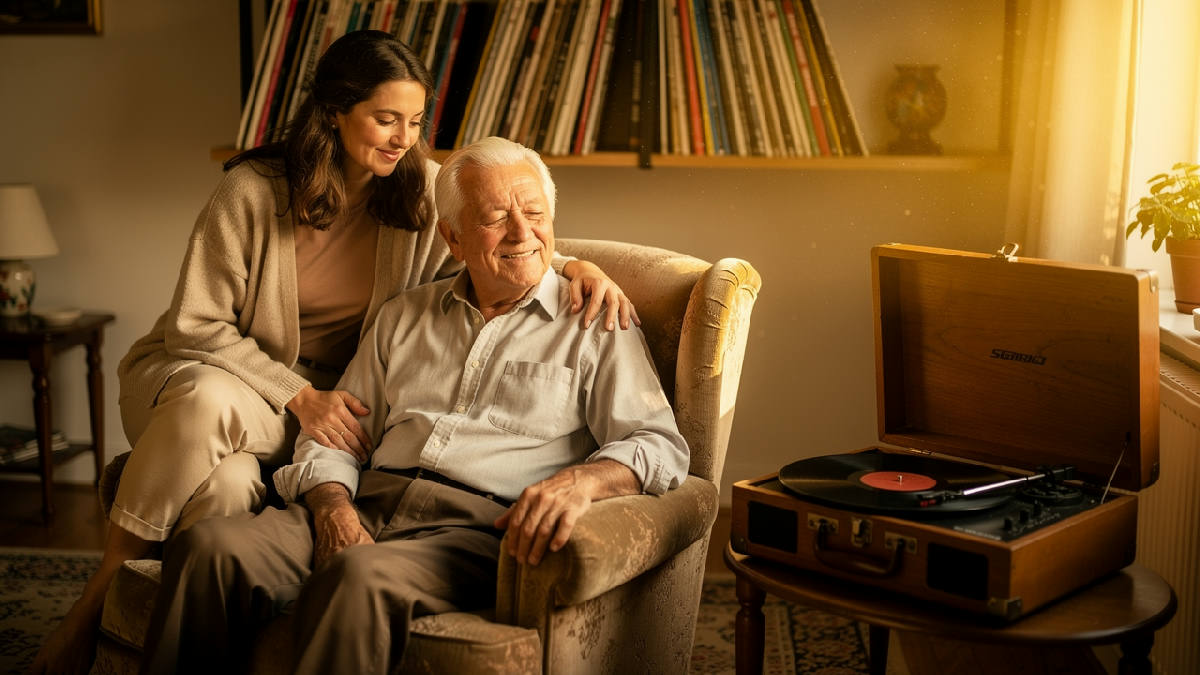
Most of us have had it happen. A song comes on in a kitchen or a car, and **a whole afternoon from decades ago** is suddenly there.
Researchers tested it in a simple setup. People heard **30 songs** and saw **30 famous faces**, then described any personal memory each one brought to mind. The memories from the songs were **more vivid.**
It was a lab study of one kind of cue, not a study of families. Still, it gives a gentle idea to carry into a conversation: **ask what song takes them back,** and listen to the story that follows.
1. Songs and faces, side by side
The team played participants **30 songs** and showed them **30 famous faces.** After each one, people described the personal memory it brought up, if any.
The descriptions were written down and scored for **how vivid they were.** The researchers had predicted that music would win, and it did.
Same people, same task, two kinds of cue. The music came out ahead.
2. What the song memories held
Memories brought up by music held **more internal details,** meaning what the person felt, thought and was doing inside the moment, and **more perceptual details,** such as sights and sounds.
Memories brought up by faces held more **external details,** the surrounding facts. One kind reads like a scene you are standing in. The other reads like a note about it.
Women described more vivid memories than men for both kinds of cue.
A song seems to hand people back the feeling of the moment, not only the facts.
3. The honest part: this was a lab, not a family
The paper tested **songs and famous faces,** not family photos, voices of people you love, or stories told to a relative. The pages we could read **do not state how many people took part,** so this page states no numbers beyond the 30 songs and 30 faces.
What it offers is a **small, useful nudge.** If you want a richer story from someone, a song may be a better way in than a name or a date.
A narrow finding, honestly limited, and still a good question to ask.
Music-evoked memories were more vivid than face-evoked memories.Summary of the findings in Belfi, Karlan and Tranel, Memory, 2016, as given in the journal abstract
What you get with LifeScribe
- A 2016 paper in the journal Memory compared music and famous faces as memory cues.
- People heard 30 songs and saw 30 famous faces, then described the memories each brought up.
- Music brought back memories with more internal and perceptual detail.
- Faces brought back memories with more external detail.
- The study did not test families, family photos or recorded stories.
- Built on documented research: Belfi, Karlan and Tranel, Memory, 24(7), 979 to 989, 2016.
Start free, with nothing to lose
Just a phone call, free. Ari listens, asks about your life, and keeps your stories in your own voice for the people you love.
The song that takes someone back is a door to a story. Ask for it while they can tell it, in their own voice. It is just a phone call.
Ask what song takes you back.
Ari calls, listens, asks what came next, and keeps your stories in your own voice for the people you love.
Questions grandparents ask us
What did the study actually find?
In a 2016 paper in the journal Memory, memories brought up by songs were rated as more vivid than memories brought up by famous faces.
Who ran it?
Amy Belfi, Bruno Karlan and Daniel Tranel, published in Memory, volume 24, issue 7, pages 979 to 989.
What kinds of details differed?
Song memories held more internal and perceptual details. Face memories held more external details.
Did it study families or recorded stories?
No. It used songs and famous faces. This page makes no claim that a song changes how a family story is told or kept.
Why does it matter for a life story?
It suggests a song may be a good way to start someone talking. Telling the story in your own words keeps your version for your family.
https://getlifescribeapp.com/blog/the-song-that-took-them-back